music_noteJUST RADIO



Ben Jameson
access_time10:00 pm - 12:00 am
The troubling lack of data behind Australia’s social media ban on children | Science, Climate & Tech News

The trouble with the scientific evidence behind the social media ban in Australia is that there is not more of it.
This feels wrong on every level. We have all heard the stories – there are so many, you can hardly avoid them. And everyone who’s ever used social media knows it can be frustrating, to put it mildly.
Sure, it has its benefits. But it often feels empty, addictive or actively undermining. And that’s even before you get to its more dangerous side, in particular for children – sexual predators, say, or disturbing and inappropriate content.
File pic: iStock
What’s more, there’s a worrying trend around the world which common sense tells you can only be explained by social media.
Teenage mental health is in decline, especially among young girls. In Australia, one measure of good mental health has fallen by 10%. A measure of bad mental health, self-harm admissions to hospital, has risen by more than 40%.
There are similar trends around the world.
Globally, depressive symptoms have jumped in adolescents worldwide, going from 24% in 2001-2010 to 37% in 2011-2020.
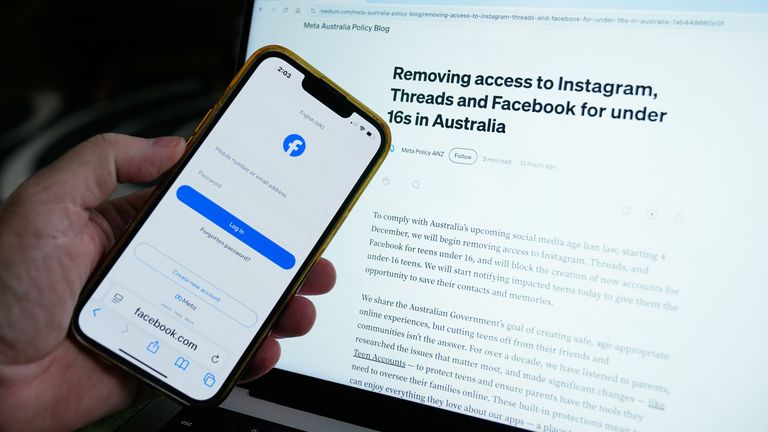
A logon screen for Facebook and the new Meta policy in Australia. Pic: AP
When did the decline start? Around 2010.
What else happened in 2010? Social media went mainstream. The conclusion seems so obvious it’s hardly worth investigating.
Except that when scientists do investigate it, they cannot find the connection. The relationship between social media use and negative health outcomes is tenuous at best.
In 2024, a team of scientists from the University of Cambridge analysed 143 studies searching for a connection between social media use and psychological problems like anxiety and depression. They found one, but the correlation was very weak.
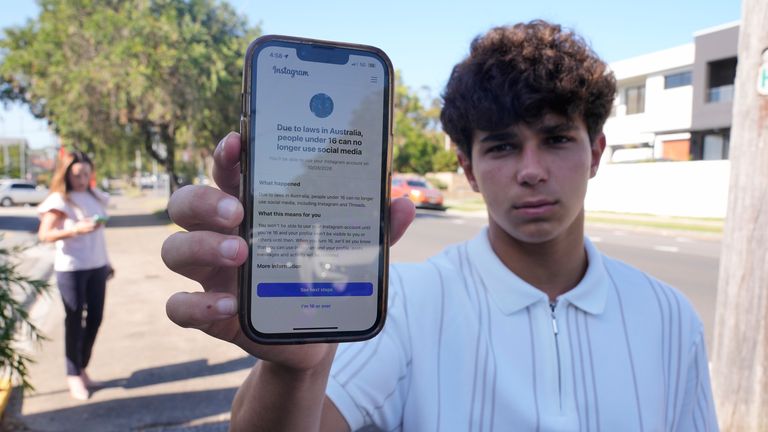
Sydney teenager, Noah Jones, 15, shows the warning on his phone that says he cannot access Instagram. Pic: AP
Correlation tells you how tightly two things move together. For example, the link between the amount of alcohol a person drinks and their blood-alcohol level is extremely strong, with a correlation around 0.90. Height and weight show a solid relationship, at about 0.75.
This large study, which in total included 1,094,890 adolescents, put the link between social media use and mental health symptoms between 0.08 and 0.12.
The effect may be real, but compared with classic examples of strong correlations, it is tiny.
Time and again, studies confirm this finding. You would think, for instance, that if social media were bad for people, then the arrival of Facebook would cause well-being to plummet.
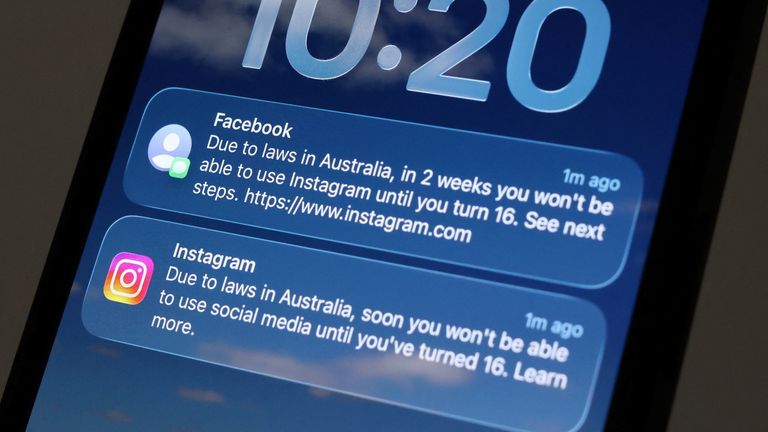
Facebook and Instagram alerts are displayed on a child’s mobile phone in Australia. Pic: Reuters
Well, researchers studied this, looking at Facebook adoption in 72 countries from 2008 to 2019.
“We found no evidence suggesting that the global penetration of social media is associated with widespread psychological harm,” they concluded.
Read more:
Children seeing social media content ‘designed to hook adults’
Online grooming crimes double, with victims as young as four
There was some impact on younger people, but once again, it was mild, and the picture was mixed.
“What that tells us is it’s very hard to make decisions about how to intervene at a population level because the evidence of harm is not really clear cut and the findings aren’t clear cut,” says Victoria Goodyear of the University of Birmingham.
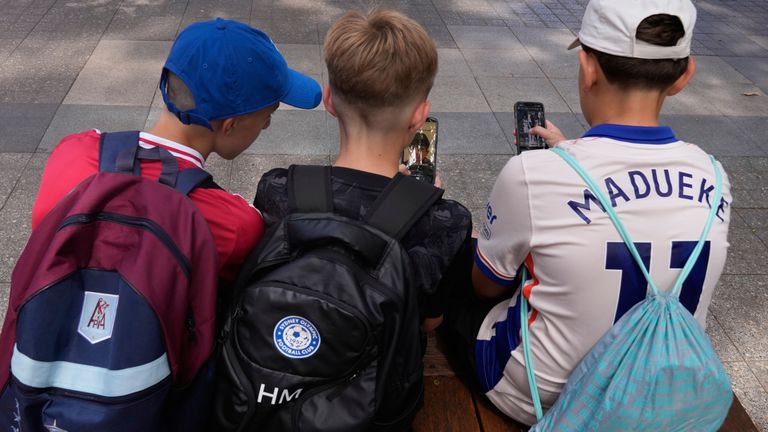
Australian schoolboys use their phones while sitting outside a school in Sydney. Pic: AP
This conclusion is far from decisive. Social media might generate oceans of data, but only the tech companies really get to see it, so researchers are working with extremely limited material.
One big source of information is diaries made by teenagers chronicling their social media use and symptoms – perhaps if there was a better way of measuring what’s really going on, we would get a different picture.
Of course, there are researchers who believe passionately that social media is undoubtedly harming children, most notably Jonathan Haidt, author of The Anxious Generation, a book which has become a bible among parents campaigning for smartphone bans.
I asked Dr Goodyear what she thought of The Anxious Generation.
“I’m not going to comment on that one,” she replied.
This is a common response among researchers in this area, who privately believe that Dr Haidt has left the evidence behind in his crusade against smartphones and social media.
Those who do put their heads above the parapet are often sharply critical. A review of Dr Haidt’s book in the scientific journal Nature called him “a gifted storyteller, but his tale is currently one searching for evidence”. For academics, this is savage.
Critics of Dr Haidt say that the problem is the other way round. It’s not that social media causes depression; it’s that adolescents with depressive symptoms interact differently on social media. Banning social media for this is like cracking a nut with a sledgehammer, as it will remove the benefits without necessarily treating the problem.
Instead, they argue, we need to rethink the way children are treated by society more generally, giving them fun and freedom so they are not pushed towards screens.
As the Nature review of The Anxious Generation concluded: “We have a generation in crisis and in desperate need of the best of what science and evidence-based solutions can offer. Unfortunately, our time is being spent telling stories that are unsupported by research.”



Post comments (0)